
|

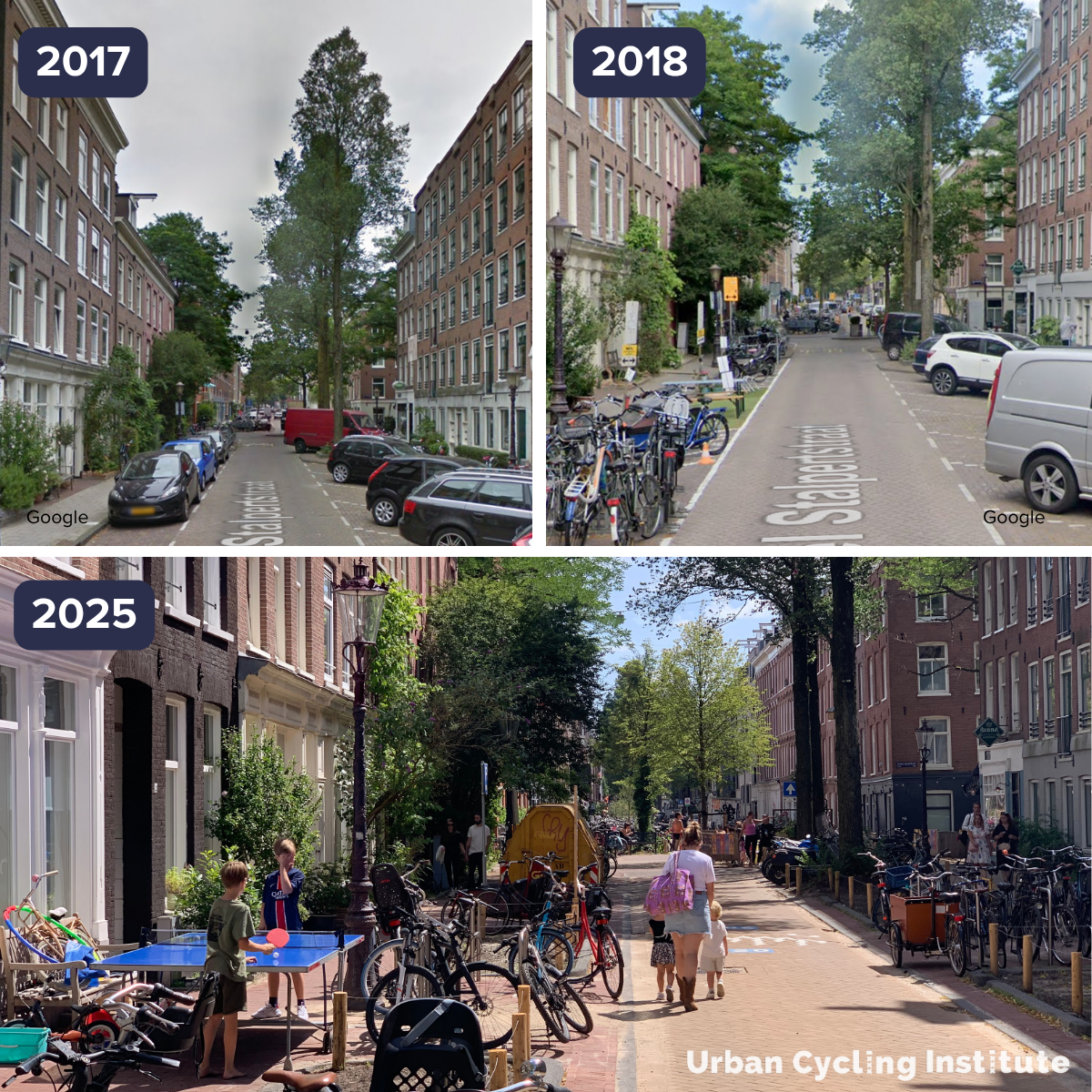
Photo montage from the Urban Cycling Institute shows the before and after states of Daniel Stalperstraat, the street where we recorded this episode.
Dr. Meredith Glaser is the CEO of the Urban Cycling Institute, an urban planning lecturer at the University of Amsterdam, and a Professor of Cycling at Ghent University. This conversation is part of a series with leading European bike thinkers. Austin, Albuquerque, and Albany aren’t Amsterdam, but there’s a lot we can learn from how European cities have navigated many of the same challenges we face in the US. Most of these discussions will be studio recordings, but this is a special conversation I recorded with Dr. Meredith Glaser on the streets of Amsterdam.
Transcript
Avi Stopper (00:09)
Welcome to Bike Networks Now. I'm Avi Stopper, the founder of Bike Streets. Through a series of conversations with leaders in bike transportation and beyond, we're trying to answer a question: Why is bike transportation still not possible for most people in American cities, and how can we make it a reality? Despite voter support and billions of dollars of investment, there's no city in America where biking is a practical reality for people of all ages and abilities.
Why is that? And how can we fix it so anyone can ride to the places they want to go today? These aren't just freewheeling conversations — we're in search of an answer. And that answer, a modern approach to innovation, is the topic of a book we're writing on how cities can make bike transportation possible today.
Avi Stopper (01:06)
This conversation is part of a series with leading European bike thinkers. Yes, we know Austin is not Amsterdam, but there's a lot we can still learn from how European cities have navigated many of the same challenges we face in the US. Most of these discussions will be studio recordings, but this is a special conversation I recorded with Dr. Meredith Glaser on the streets of Amsterdam.
Meredith Glaser (01:37)
So, my name is Meredith Glaser. I am CEO of a nonprofit called Urban Cycling Institute. But I also wear many hats, so I also have an academic appointment at the University of Amsterdam as a senior lecturer in urban planning. And I am appointed professor of cycling at Ghent University.
Avi Stopper (01:57)
What a title. There's got to be at least one. May there someday be many more. Please pave the way.
Meredith Glaser (02:04)
In Germany there are also some professors of bicycle traffic, as they call them. There are seven of them in Germany, endowed several years ago. My chair of cycling at Ghent University is also endowed by the Ministry of Mobility and Public Works. So it's a chair that works directly with the ministry.
Urban Cycling Institute is a small nonprofit. We are an academic institute with roots in academia, but we aim to translate research into practice. We do that through what's called valorization — the grand fancy term for creating societal impact with research.
So we work directly with cities and governments and ministries, also with other universities, creating new types of curricula for students and also new types of leadership programs, professional development for professionals in the field — again, with this eye on translating research into practice.
Avi Stopper (03:25)
What are some examples of interesting current research that illustrate the idea you're trying to bring to the masses?
Meredith Glaser (03:33)
Well, we use a lot of the methods and research from my own PhD on best practice learning. So: how do professionals learn about best practices around cycling? And how does that learning translate into building capacity for their organizations and institutions?
For the most part, what I found was that the immersive experience of learning about cycling is by far the most important variable.
Avi Stopper (04:04)
Immersive — does that mean riding around and really getting in it?
Meredith Glaser (04:06)
It's what we are doing right now. That's what we are doing.
And that's what makes it so special: that when you are using the system yourself, when you are learning about streets in a very expansive way. So thinking about streets as public spaces and places, thinking about streets as a way to build community health and social cohesion. These are not just abstract concepts.
In order to really learn about them, you have to experience it. You have to be here. You have to talk to locals. Yes, you can learn from experts, but having that firsthand knowledge is what creates a fundamental mind shift. You've got to feel it.
And then the way that we do it with the cities and governments we work with is through study visits.
Avi Stopper (04:54)
You've got to feel it.
Meredith Glaser (05:04)
Which are then a collective of actors and government stakeholders who are experiencing it all together. That creates a very different dynamic, because you have different representatives from government. So let's say the Chamber of Commerce, and the bicycle-pedestrian coordinator, and the head of the transport department. And the fire chief, right?
You have all these different personas, different actors coming together, and they're all learning about streets and cycling at the same moments. Looking at the same things together, and then discussing it and talking about it and asking each other: how does this relate to our hometown? How does this relate to the policies that we are initiating or working on? And the programs.
So that's really what we work at. It's really the intersection of transportation planning, urban planning, and change management. How do we change our organizations, our governance, the way we are working together on this big, big, big thing called the mobility transition?
We have to have different perspectives come together, because creating places like this — where we see our streets as more than just mobility, seeing them as more than A to B, more than efficiency — that means looking at it from a very expansive view, integrating public health, ecosystems, greenery. I look around at this space right now and I see places for people to sit and enjoy, for children to play, for new narratives of mobility to be enacted.
Avi Stopper (06:56)
Just to paint a little portrait of where we stand. First off, I'm looking at a tree that has a bunch of signs on it, and one of those signs says "shh." Just shh. That is definitely worth taking a photo of.
But what's interesting about this is that we're on a street. There is a shared-use driving lane where people can ride bikes. There are about a bazillion bikes parked. There are these incredible gardens that separate the driving lane from where folks are walking, maybe—
Meredith Glaser (07:30)
Swales, actually. These are bioswales. Very efficient flood mitigation.
Avi Stopper (07:36)
And then there are benches as well. There are places to sit.
Meredith Glaser (07:39)
Also very permeable surfaces, right? The bricklaying here is a fundamental piece of the Amsterdam street design manual, which was published about a decade ago, and it's called the Puccini Method. The Puccini Method dictates and prescribes certain types of street design elements and how they are put together, in order to create this cohesive manual but also a cohesive look throughout the city.
So this very traditional — it's become an icon. The red pavement of Amsterdam has become a standard norm in the street design guidelines. Truly. And what we're looking at is exactly what they have created out of this manual.
Avi Stopper (08:24)
I should note I was sitting on the street for a while at a cafe, and there's also a flock of feral parrots.
Meredith Glaser (08:31)
Oh yes. The green ones. They're very loud.
Avi Stopper (08:33)
They're very, very gregarious fellows.
Meredith Glaser (08:36)
Yes. But you know, to me the most interesting part of being on this street is that only eight years ago this looked and felt very, very different. Where we are standing right now, we would have been standing on a car. This was rows of car parking a very short time ago.
The city underwent this large public participation process with this community here. There's a series of about seven or eight small streets in this neighborhood, and the city went to this community and asked: what are you missing? And they came back — we're missing bike parking, we are missing trees, we are missing places to sit and meet each other.
With that, the city then came with a design and said, okay, we want to meet your needs, but this means that we have to negotiate on car parking spaces. We actually have to take away 180 on-street car parking spaces in this neighborhood in order to meet your desires of more greenery, more bike parking, things like that.
So of course there were certain community members not really excited about that. This is a very diverse neighborhood. It's originally a very working-class neighborhood, and also extremely dense — one of the densest neighborhoods in Amsterdam, even though it's only three or four stories. These are very small apartments. People are living on top of each other. Very small living quarters.
And this is a neighborhood that is rapidly gentrifying — for, I would say, fifteen, twenty years or so. So it's certainly on the map in terms of trendy, up and coming, real estate, also other land uses here. You can see the fancy coffee shops. Or cafes, I should say.
Avi Stopper
It's an important distinction, yes.
Meredith Glaser (10:49)
It's important to recognize the historical dynamics of gentrification and the potential negative impacts of it. Especially with regards to street design. What happens when you upgrade streets and potentially impact property values, and then residential turnover — all these processes that can become negative to the community.
But there were some people — elderly people, people with disabilities, parents who have kids and have cars — some of these neighbors were actively saying, no, we don't want to change the streets.
So what the city decided to do was have a very phased approach. The first step was very temporary, tactical almost: planter beds and bicycle parking that was very temporary. They didn't change the space at all besides putting some planter beds in — removing a few parking spaces per street, putting these planter beds in, and creating this temporary bike parking out of the car parking. You can see this on Google Street View very easily.
The point of the interim experimental approach was to say: hey residents, let's just try this out, see how you like it, and if it goes well, then we'll continue with the design phase.
Meredith Glaser (12:17)
I think all along they had planned the design phase. But experimenting with reallocating public space, especially streets, is a very strong approach to build community consensus around change and adaptation.
So all six streets underwent this very temporary transition almost overnight. It was a very simple process. I remember actually seeing them filling these very temporary planters full of soil and seeds. And you can easily see them on Google Street View, which is fun to see. Then after a year or so of that, they transitioned to the long-term design process, which is what we see today.
Avi Stopper (13:13)
It wasn't always this way.
Meredith Glaser (13:14)
It wasn't always this way. Even in the sixties, seventies, eighties, you can see pictures of what these streets looked like — even without this tree canopy here, which is already sparse — and packed full of cars.
This is the heart of the Stop de Kindermoord campaign, which in English is Stop the Child Murder. In the 1970s, children were being killed in traffic at really high rates in the Netherlands. The father who started this campaign actually lost his child in a traffic crash. He was a prominent journalist at the time, and so he wrote a newspaper article called Stop de Kindermoord — Stop the Child Murder. We have to do something about cars in our city.
So this is the heart of it, right here. And that momentum and grassroots movement started a change process that was significant.
Avi Stopper (14:17)
What strikes me is the universality of a lot of the arguments in favor and against — a lot of people favoring these types of spaces, a lot of people concerned about them. Even in Amsterdam that happens to be the case.
Let's cut to the chase. What ends up happening to those folks who live on this corridor, who drive? Where are their cars at this point?
Meredith Glaser (14:39)
Very interesting question. At the same time that the city was undergoing this public participation process, they were building a multi-million-euro underwater parking garage.
Avi Stopper (14:52)
Not underground — underwater.
Meredith Glaser (14:55)
Just underwater. They drained this canal, built a very expensive car parking garage, and then refilled the canal. So, leave it to the Dutch to deal with modern competency.
It is important to note that since this neighborhood is in the city center of Amsterdam basically, it already has a very low portion of car ownership per household. Somewhere around thirty, forty percent of households own a car in this neighborhood, which is relatively low.
And the city said, okay, there are some car parking spaces for disability parking, there's of course loading and unloading spaces — but the rest of you, here's your fancy car parking garage, and you just have to walk three minutes.
Avi Stopper (15:54)
Do you have to scuba dive to get to it?
Meredith Glaser (15:56)
You don't have to scuba dive, nope.
So people can place their cars there. And so far it's been going well. What I've heard about that parking garage is that it is not nearly at capacity — not what they were hoping for. So it's actually losing a lot of money.
Avi Stopper
That's a headline.
Meredith Glaser (16:20)
Right. It's not up to the hopes and dreams that they had for that parking garage.
But I think it does highlight conflicts — or paradoxes — of, okay, yes, we want to move cars to a parking garage, and then that allows for public space to have a much different character. And also, maybe the forecasts are wrong. The forecasts of the desire for parking in that garage are also shifting. The people who are moving into this neighborhood don't own cars in the first place. So perhaps the car ownership rate is actually decreasing over time.
So I think it's a great example. Even though there's low car ownership, I think there are still lots of lessons to be learned — and in this particular case, the lesson around experimenting, testing, trial, pilot. How do we build coalitions of diverse community actors to understand how street space can be used in different ways?
Avi Stopper (17:38)
I'm so glad you said that. You are speaking my language.
I find it to be so sad that these missed opportunities tend to be the standard in the United States, where rather than giving people the opportunity to see how a street or an environment could be transformed, we go through this protracted process, we yell at each other a bunch, and then something watered down goes in — rather than people being able to experience it. And on the rare occasion where experiential design, what I like to think of as experiential design, has been part and parcel of it, people seem to generally love it. Their neighborhoods are transformed.
It strikes me that it's asking a lot of folks to have them go to some public meeting, look at a poster, and be like, yes I want that, or no I don't — or have some deeply informed engineering sense. Like you were describing at the outset, people need to experience these things. And when you start to experience something like this, you're like, wow, I didn't imagine that something like that could be possible.
So I'm encouraged to hear, first off — for those of us who dwell in cities that don't have as established a network as this one, which feels like it's just everywhere — I'm encouraged that the work continues, that the evolution continues, that it's not a steady state. That it's not just like, hey, we landed here from outer space and everything was like this.
And I want to ask you this, because when I was riding around Amsterdam all over the place like a crazy man yesterday, I had this sense to a degree that if people —
Avi Stopper (19:19)
— if decision makers, like the folks you describe bringing to town, are to come here and experience it, they might be overwhelmed by the level of development and just feel like this is an impossible lift. How do you handle that type of objection?
Meredith Glaser (19:37)
Yeah. I come back to, well, one: this didn't happen overnight, clearly.
If we take it back to cycling — the development of cycling networks, investments, infrastructure, policy — this goes back decades. I mean, it actually goes back a century, if we think about the Dutch cycling culture. The Dutch were not born on bikes, no. But in the 1920s and '30s, after the bicycle revolution started, where bicycles were being produced in factories for mass consumption, bicycle use was at a very, very high rate. Up to eighty percent of all trips by bike in the twenties and thirties. This is huge. This is more than it is now.
So there is that slight cultural element — that the bicycle has been here a long time. There is something about the Dutch roots of Calvinism and pragmatism and frugality that really match well with the bicycle.
But I am not one to say that it's culture before policy. I think there is definitely an element of saying infrastructure and policy go hand in hand with culture. And it's been a very long ride of policy, of investments, from the national level to the regional level down to the local level. And it is so intertwined with other elements of urban planning, such as housing development. The Dutch do a very good job of integrating land use and housing and transportation. These are in the planning culture of the Netherlands.
Meredith Glaser (21:44)
And that's very different from other places, definitely.
But we do have people coming who are like, this is so far in advance — what can we even learn from this? And this is why I love taking people, particularly policymakers, to places like where we are right now. Because it is a phased, experimental approach that happened over a decade. This was a decade of work, this project here. And it had to start somewhere.
What we also talk about a lot in these study visits are windows of opportunity. How do you identify those windows of opportunity? How can you create and nurture them, and progress through them by using them?
And these windows can be very diverse. They can be new leadership coming in — either a new mayor or a new head of department. But it can also be global events like COVID. And we saw that. COVID made big waves when we talk about streets and public spaces. There were communities all over the US that really activated and galvanized momentum around changing streets in a very tactile way, guerrilla way.
Avi Stopper (23:13)
I'm obsessed with those, by the way, just for the record. We did that in Denver, and they were wildly, wildly popular. It was remarkable to see.
This is an interesting space. When you think about this as a space in and of itself, it's one thing to transform a point location or a short corridor. A transportation network — and this show concerns itself mostly with the creation of connected bike networks — is a different beast to a degree, because we're not just talking about an isolated location. We're talking about how do you traverse a city to make any type of trip that you might want to make possible.
And I'm curious to hear your thoughts on what I see as something of a catch-22. The catch-22 is: you've got to start. You've got to start doing it, and you've got to take those windows of opportunity as you describe. But by the same token, the lack of coherence and connectedness from the outset makes it very difficult to navigate those quote-unquote networks.
So yes, you're starting, you're doing the work. But then a lot of people who are circumspect about it at the outset have this kind of confirmation bias in place, and the confirmation bias tells them: see, we told you that no one was going to use it.
Of course, by contrast, here you sit — as I have done a few times — and just count the number of people who go by, and observe the interesting configurations. These things are so heavily used, it is totally unimpeachable that they are getting that kind of use.
But we have this catch-22 in the US, or at least, I would imagine, in a lot of cities around the world, where you want to start, you want to build the network, but you're not getting the network done in any sort of immediate fashion. And as a result it becomes exclusionary, because most people look at it and they say, I can't do that. I can't do that. Because you have gigantic gaps. You might have one really well designed facility that goes for a mile, and then it drops you off in traffic.
How do you reconcile that? Where do you encourage these overwhelmed decision makers who come here and are like, whoa, how did they do that?
Meredith Glaser (25:34)
I have so many thoughts, so many ideas popping through my head.
One story that comes to mind is the city of Sevilla, Spain. Sevilla, in the early 2000s, launched a bike share program. Now, Sevilla is a mid-size, small-mid-size Spanish city. It's a university town, so maybe similar to Denver in a way — it's a young city. And it has a beautiful historic core, like many Spanish cities do.
They launched this bike share program as a first step. They had no idea what would happen. Well, it took off. It was successful from the start, fairly successful.
Then there were a couple of civil servants in the urban planning department who noticed this, and who took it on themselves to launch a public poll. They asked the entire population about their wishes and desires around cycling. It came out that there were high, high rates of the population that wanted more cycling, more protected infrastructure, more safe streets. A huge amount. I can't remember the numbers exactly, but something like eighty percent. It was an overwhelmingly positive result.
They took this to the mayor at the time, who was green-left, and also just starting his tenure as mayor. And they then launched this very rapid deployment of protected bike lanes on only the major arterials. In something like twenty months, they built like a hundred kilometers of protected infrastructure. Fast.
And when you ride it — I rode it, this was ten years ago when I rode in Sevilla —
Meredith Glaser (27:48)
the bike lanes go around trees in a kind of strange way. They did it really fast. But they did it in a way that was also connected to the sewage, so that it would be very difficult to tear up. Because, knowing that in Spain, as in other places, if the politics swing the other way, then there could be a risk that it's gone tomorrow. So they did it in a way that would be very difficult to tear up, and they built it in a year and a half. Very, very quick.
Cycling just went through the roof. Their rates went from like one percent of all trips to fifteen percent with this improvement. And that built this huge threshold of popular support.
And it did turn out that the next term, a more conservative politician came into power and stopped the progress on cycling infrastructure, which then stalled the increase of use. But it stayed around fifteen percent.
Avi Stopper (28:56)
Once you have a deeply engaged group of folks — I'm guessing that guy wasn't able to remove it. Progress couldn't continue, but he couldn't remove it, because it had become such an essential part of the transportation system.
Meredith Glaser (29:19)
Support. The advocacy groups really rallied around this. Student groups rallied around this. There was a lot of support for cycling, and it would have been very difficult to backtrack or start removing the infrastructure. So it was paused.
But if we think about the lessons here — one, there were inside activists, I like to call them. There was leadership within the civil service that took it upon themselves to take responsibility and action to do this public poll. They had some funds left over from an EU project, and there were some other things that they kind of puzzle-pieced together to launch this poll and then to build this infrastructure. And they took it upon themselves.
So: how do we get more people like that into positions of leadership working within city government? They knew the right people to talk to. They knew what they needed to do in order to make change. What an incredible lesson.
They used data in a very strategic way. They used this public poll to gather consensus, to be able to have this breadth of evidence to say with confidence to the mayor: this is what your constituents want.
Avi Stopper (30:39)
Okay. So let's not pretend that this is formulaic, but to a degree it's kind of like: however you can — whether it's bringing people to Amsterdam as you do — convince them that this is indeed something that can dramatically upgrade a city. And when you have supportive political leaders in place, strike while the iron is hot and get it done quickly. Because you never know when your fortunes are going to change. But theoretically, if you get it done quickly, there is indeed this latent demand that the network activates.
Meredith Glaser (31:10)
Demand. That's the thing.
In the US there's been fantastic research showing that around fifty percent of urban populations want to ride. They're interested but concerned. This is a famous paper. I can send you the paper — the interested but concerned.
They are concerned about how bicycling fits into their life. They're concerned about safety. They're concerned about how they can get their groceries and their kids at the same time. These are the types of concerns that the everyday person has. But they're interested. And that's the important part. Fifty percent.
We also know that many, many trips in the US, especially in urban regions, are short trips. Something like sixty percent of all trips are a bikeable distance of, what, three miles let's say maximum. We want it to be less than that, but yeah.
Even in Europe, most trips — something like half of all trips — are under a mile and a half. And these are mostly car trips outside of the Netherlands. Especially in the US, they are car trips. These are trips that can be easily transferred to either walking or cycling.
But the environment doesn't allow that. The environment dictates that driving is the way to go, because people feel unsafe, they feel insecure, there are no protected bike lanes, there are many, many cars driving very, very fast. Big cars. Lethal cars. So the walking environments, the biking environments are not conducive to those short trips that can be easily transferred.
Avi Stopper (33:01)
I want to talk a little bit about some of the actual facilities themselves that I've observed while I've been riding around.
Just to give you a little context: our group Bike Streets, which in Dutch, funny enough, translates to fietsstraat — which is actually a type of street that we'll get to in just a moment —
Meredith Glaser (33:15)
Straat.
Avi Stopper (33:21)
— is developing and has been advocating for an approach that we call network-first. The idea is that rather than building individual isolated facilities — what I think of as a disconnected archipelago, in some cases very well designed, highly engineered facilities — a route is only as good as its weakest points. And if there are all these gaps, it doesn't really matter that much how good an individual facility is.
So with this network-first approach, we rely heavily on the idea of shared-use facilities. And shared-use facilities not in the conventional American shadow kind of sense, where you have people riding in traffic, vehicular cycling. But rather what I think I have seen all over Amsterdam, including the street we're standing on right now — a street that is nominally shared use, but where the design has reduced traffic volumes and speeds dramatically.
I'm curious to hear your take on that. You have this really unique perspective. You're here, you're teaching the world what you have learned from the Netherlands in terms of how to create these types of systems.
Avi Stopper (34:38)
What is your take on those types of shared-use facilities? Because one of the key things is that if you're thinking about it from a network perspective, it's expansive, really costly, and potentially dramatic in terms of the conflict that it could create when you chill a street out — kind of like the street that we're standing on right now. What's your take on using that typology as a way to work ourselves into a complete connected network, if not the perfect network of the future?
Meredith Glaser (35:14)
Yeah, well, these were some of the first steps that were taken here in Amsterdam and many Dutch cities: traffic calming. Like, very severe traffic calming. So things like what we're seeing right now — here's a raised table, speed humps, one-way streets, and just overall speed reduction. These were certainly techniques and measures put into place in those early days of the '80s. And they're very effective, for the most part.
I think one of the most powerful policy measures that any contemporary city could put into place right now is a traffic circulation plan — an entire citywide circulation plan. This is the routing of car traffic, including one-way streets, essentially making car travel less convenient.
The city of Groningen in the '70s is probably one of the most famous examples of a traffic circulation plan. They took the city, if you're looking at a bird's-eye view, and they chopped it into four quadrants, and then said: if you are traveling in a car, you cannot go directly from one quadrant to the next. You have to go outside of the quadrant and go all the way around and then in.
So that makes it much more time consuming as a car driver, to not be able to drive directly through a city. But what it does is open up the city for bicycling, for walking, for things like planting trees. And this is a very, very effective and cost-effective measure to put into place.
So the city of Ghent actually did this, copying Groningen. And they called it the flower petal plan, because — yes, it sort of
Meredith Glaser (37:30)
quote-unquote chopped the city. But that's a little bit violent to say. So they drew these flower petals around the city center, I think five, and made it impossible to drive a car through the city, or from petal to petal. You have to go outside of the petal and then around and back in.
They did this with five million euros. Cheap. Super, super cheap. And it took about two years of preparation.
Avi Stopper (38:07)
Two years of preparation.
Meredith Glaser (38:10)
Two years of preparation — the bollards, the one-way signs, some streets had to change. And then overnight they did it. Overnight. From one day to the next.
Meredith Glaser (38:22)
And the media were there waiting for the collapse of the city. The deputy mayor, who is the father of this plan, received multiple death threats, had to have security at his place of residence. It was extremely conflict-ridden and contentious.
Overnight it was installed, switched on. And within a few weeks, the results were already very visible and tangible. I think there was just a ten-year evaluation report released showing that cycling has increased by thirty-seven percent, or maybe even more; that air pollution has decreased, noise has decreased. Basically, residents themselves are extremely favorable toward this policy.
And what he noticed — I love his story about this. On the day that it was launched, he had all these media journalists walking with him through the street, and many residents waved to him, waved to the deputy mayor, saying: good job, good job, this is great. And he thought to himself: where were you during this whole process? Where were the people who said, yes, I want this?
He noticed that these people were quiet this whole time. Why were the supporters quiet? It was always the naysayers who had the loudest voice — and didn't get their way. He plowed through and he saw it to the end.
Meredith Glaser (40:14)
And there's no way that it would be taken back at this point, because it's such a favorable policy. The economic benefits have also been shown. In the city center, rents have basically stabilized, but there's less turnover, there's less vacancy, shop owners are extremely happy. There's more space for terraces, for restaurants and businesses to see customers on the street. Because people actually now enjoy sitting and drinking their coffee and eating their dinner on the street, because it's quiet and you can hear the birds chirping.
So if you ever get a chance to go to Ghent, I highly recommend it, because I think for a mid-sized city this has just worked so well. And it was so cheap — but it was not politically cheap. Politically very conflict-ridden. But if you have the opportunity and the willpower to do this, then certainly a traffic circulation plan can create huge benefits.
Avi Stopper (41:27)
So: low cost, move quickly, strike while the iron is hot where you have the political support. And it sounds like it takes a political leader with vision and conviction and a willingness to see out that vision, with potential consequences — at least up front — that are uncertain. But with the vision comes a belief that it's going to be awesome once all is said and done.
Okay, so I want to ask you about some of the showstopper facilities, bikeways that we see when riding around Amsterdam. There's no shortage of these incredible cycle tracks, there are dedicated bridges, so on and so forth.
What I want to ask you is whether you feel like, at least for cities that are in a very beginner phase of this kind of transformation — if people come and see those showstopper types of facilities and get those locked in their minds, and that is what they start to advocate for, rather than connectivity, rather than simple traffic calming. Whether you feel like those are actually facilities that need to come later, because they're complex, they're costly, they're upgrades to an existing network.
Which is to say: overall, I don't want to call them a distraction per se, but if connectivity and the ability for people to actually go to the places they want to go is the goal, is that potentially problematic — in that it can lead us astray, because we're focused on, say, a mile of something here, rather than connectivity and how we achieve that in a short period of time?
Meredith Glaser (43:17)
It's a tough question, because bicycle paths — and we're looking at one right now. This street across the way is a regional connection. It's a street that's governed by the region, not the city. And it used to be a fifty-kilometer street, which is what in miles per hour?
Avi Stopper (43:54)
Thirty. Very high, just for reference.
Meredith Glaser (44:00)
Thirty miles per hour street. Yes, the fifty-kilometer inner-city street is a higher-speed street. It usually has more cars. Volumes are higher, speeds are higher.
And about ten years ago the city of Amsterdam embarked on a vision of transforming all of the streets in the city to
Meredith Glaser (44:16)
thirty kilometers. So, eighteen miles an hour. And finally, about a year ago — a year and a half ago — that was enacted. And again, almost overnight. Well, it took some preparation, but overnight the street speeds on these main arterials were decreased from fifty to thirty.
So that's what we're seeing over there. Now it's a thirty-kilometer street. And of course it does have this separated bike path on either side.
Avi Stopper (44:53)
There are the driving lanes, there is a lane of parked cars, and then on both sides there are raised and separated — at least on one side — cycle tracks. In the classic red brick.
Meredith Glaser (45:09)
Classic red brick, yes.
And I think I would say that this is necessary — the separated quality — because of the speeds of the cars going fairly fast, especially as a fifty-kilometer street. But as the city downgrades some of these streets, they are also removing bike lanes.
That's something you can see on the fietsstraat, on Sarphatistraat. There used to be a white stripe designating the bike path and the car lane. And because it was downgraded to a thirty-kilometer street, they actually removed the bike lane and combined it. So it's now a fietsstraat, where you as a car driver cannot overtake — you have to stay behind cyclists, you have to drive fairly slow anyway.
But they did this in conjunction with traffic circulation planning. So now, because of the circulation, there's really no reason to be driving on that street unless you're visiting a friend on that street or something.
Avi Stopper (46:27)
I think this will blow people's minds. I was having coffee yesterday with Ruth Oldenziel, the cycling history professor. And she described to me that in the evolution of a facility, the fietsstraat is actually maybe the end state. That's kind of the ambition.
I didn't really understand what that meant until I was out riding. And I think what you just described will blow people's minds — this idea that the separated cycle track, the protected bike lane itself, is not, at least by her description and from what you just said, the end point. It's an intermediate state, where the final state is that the street itself is so heavily used by cyclists, and traffic volumes can then be reduced to such a degree along with speeds, that the whole street — not just a narrow bike lane, but the whole street — becomes a cycleway.
Meredith Glaser (47:30)
Yeah, yeah. And where we just were, on Ferdinand Bolstraat, where you were having your coffee — that street used to be bi-directional for cars, with a bike path and a tram running down it. So the cars would drive on the tram tracks. This was a very chaotic street, and you can see images of it from Google Street View from fifteen years ago. There were also parked cars. Very little sidewalk space, no space for bike parking.
What the city did on that street was cut the car network. So now cars are no longer able to drive up and down it. They can only cross it from one side to the other on the perpendicular streets. And what this did was create tons of space for people walking on the sidewalk. They doubled the width of the sidewalk space. The tram still is there, is able to run on that street. And there are plenty of cyclists.
Now, this street also happens to be a very important commercial node for the neighborhood. There are shops and cafes and restaurants lining this street, which is about a mile long. So this is a very important node to have a safe cycling experience — for cyclists to be able to stop and shop and get back on their bike and go. It's very important for people to walk and do their shopping.
So what I'm getting at is the power of context. Maybe on an arterial road where there's not a lot of commercial activity, maybe you need more separated infrastructure, where there are lots of cars. But on a smaller commercial street, if you just get rid of the cars, then it opens up a lot more space for people cycling and walking.
Avi Stopper (49:46)
One thing I feel like I would be remiss if I didn't ask: does it absolutely suck to drive a car in Amsterdam?
Meredith Glaser (49:53)
It's funny you mention this, because I was in a taxi a couple months ago. I don't get in taxis very often, and I can't remember why I needed to be in a taxi. But I was telling the taxi driver, yeah, go left and right here. Go left and then right and then left. But I was giving him biking directions.
Avi Stopper (50:15)
And the taxi driver couldn't do that.
Meredith Glaser (50:17)
He's like, you just be quiet, I know how to drive here.
And yeah, it's very different. It's much less convenient. You really have to know which ways, and follow your Google Maps or whatever you have, because you have to go much more in a circuitous route in order to get to your destination. And then parking. Parking: nine euros an hour.
Avi Stopper (50:44)
Nine euros an hour.
Meredith Glaser (50:47)
Right. So this is one of the highest parking rates in Europe. And it's also a major lesson for people who are visiting Amsterdam — it's much cheaper to come by train, or to park outside of the city and take the metro in. And that's what they're actively promoting.
So when we think about our cities and mobility, we have to think about the carrots and the sticks. You were just talking about building a bike network — this is a carrot for biking. But we cannot do that without also thinking about the sticks for driving. There has to be this balance of both. Because otherwise — I mean, you can't please everyone, certainly.
And we have to ask ourselves, why are we doing this? I love the idea of people getting together and really thinking about network connectivity, but I think as a group you can also ask yourselves: well, what are the sticks here?
And even beyond that — the next phase of Amsterdam, which may be a question you have, I don't know, but what's next for Amsterdam? There's a very interesting evolution now of thinking about, instead of transportation for transportation, what about planning for our values? And engaging in conversations around value-based urban planning.
So this is sort of the next phase here. The regional transit authority is the one that holds the purse strings in Amsterdam. The region invests in transportation projects in all of the municipalities that it governs within the Amsterdam region — so there's, I don't know, fifteen cities, something.
Meredith Glaser (52:55)
And a few years ago the region decided: we are no longer funding car priority projects. This is a huge deal.
Avi Stopper (53:04)
When you say values-based, that's how they're approaching it.
Meredith Glaser (53:09)
This is how they're approaching it. The values that they are using to gauge transport investments are mode shift, and safety for people walking and cycling and taking transit. So this is a huge shift.
Avi Stopper (53:29)
Even here.
Meredith Glaser (53:30)
Even here, yes. They had to build a major consensus around this with many different actors at multiple levels, to come together and agree that this is how our investments will work for the next fifty years or so. That we will no longer support car priority projects — we will only give subsidies to projects that encourage modal shift, and that put safety at the core of every project.
This is a big shift even for Amsterdam. So when we think about what's the next evolution here, I think in terms of American cities, that's such a great lesson of: let's get beyond the network, let's go beyond transportation. Let's think about what transportation does for our communities.
Instead of saying, you know, this street is a fifty-kilometer or whatever, twenty-mile-an-hour street — let's say this is a child-friendly street. We want every child in this community to be able to walk or cycle by themselves to school. What would that street have to look like?
It's very clear what a child-friendly street would look like. It would have slow speeds. It would have trees and flowers and unicorns. It would have puppies.
Avi Stopper (55:00)
In one of the photos that you sent me of this street, there was a ping pong table set up. Kids playing in the street.
Meredith Glaser (55:08)
Kids playing in the street. Exactly. And ten years ago they couldn't have done that here.
Avi Stopper (55:14)
Speaking of kids, I think that we are short on time — you have to pick up a special someone.
Before we do, though, I want to point out my single favorite piece of infrastructure. It's this sign combination. It's a Do Not Enter sign, and then — do you want to say that word for me in Dutch?
Meredith Glaser (55:37)
Uitgezonderd. With exception.
Avi Stopper (55:40)
Uitgezonderd. Oh my gosh. With exception for bicycles, and then mopeds.
Meredith Glaser (55:43)
Yep. So bikes and mopeds can go that way, in the opposite direction, but car drivers are not allowed to.
Avi Stopper (55:53)
And there is no additional infrastructure. There are no physical diversion points. It is that sign combination. And I have seen those all over the city. They are in existence more and more in American cities. It seems to be an incredibly effective, low-cost way to prevent people from driving in both directions, while also making it accessible by cycling.
And you should know — well, whether or not you should know, I'm going to tell you — I'm obsessed. There is a bikeway in Brooklyn on Berry Street by the Williamsburg Bridge. And I consider it to be the single most scalable bike facility in America. And it uses these signs, and alternating one-ways. So it's basically a series of these, where every two or three blocks the direction of the one-way changes. And as a result, you have no through traffic whatsoever.
Our advocacy in Denver — this is for another podcast — is oriented around using these low-cost implementations to make the network.
Meredith Glaser (57:04)
Well, this intersection here we could talk a lot about, because I really love the continuous sidewalk. This is actually an intersection of two perpendicular streets, but the sidewalk continues from edge to edge.
Avi Stopper (57:23)
Meaning that — under normal circumstances, if you were crossing a street as a pedestrian, you would go down a curb cut onto the street level and then up a curb cut on the other side. Whereas in this case, the pedestrian stays at the same grade, but the driver goes up and back down.
Meredith Glaser (57:44)
It's a huge speed table. And what it does for car drivers — because of course cars are allowed here — is that the car driver has to go up onto the pedestrian and cycling and greenery kind of space.
It's an immediate signal of: whoa, I need to watch out here. I need to look around me. There aren't a lot of signs — there's this one here too, but there aren't a lot of signs saying watch out.
And then look at the width. The width between these two planters, or green space. By American standards, this would not exist, because this is so narrow here. A car driver will have to drive so slow to make sure that they don't scrape the tree.
I think the lesson here is: let's use urban design as a tool to slow speeds and to create spaces that encourage people to use all types of their senses in order to negotiate traffic. Because even bicyclists have to navigate this space, and people walking. But people use gestures, they use eye contact.
Maybe you've been noting this while you've been riding around — that it is a very human form of mobility here. Constantly making eye contact with people. You're constantly taking in body cues, of their balance.
All types of cues are entering our brain as we cycle here, and especially using eye contact. Sometimes I like to make myself count how many times I make eye contact with people, because it's astounding. Just on my way to work the other day, I think I counted like twenty-five times.
Meredith Glaser (59:55)
It's a very transient experience, right? Just glancing at people's eyes. And you have to wonder — I mean, I put my social science hat on — what does that do to society, when you have to look in each other's eyes?
Avi Stopper (1:00:08)
A little empathy, right? Maybe. Where's that person coming from today?
Meredith Glaser (1:00:13)
I mean, maybe. It's not all rainbows and unicorns. Sometimes people are cussing at each other and still looking into each other's eyes.
Avi Stopper (1:00:19)
I got a few of those yesterday.
Meredith Glaser (1:00:21)
But that's part of being in a city: meeting the other. And I think the bicycle — we wrote an academic paper on this, actually — the bicycle has this great potential exposure to diversity. Out of all modes, the bicycle has the most potential of exposure. Because of sounds, of space, of people.
As you travel around the city, you're next to people of different classes, different races, and you're literally right next to them and can smell their perfume. And what does that do to society, when you can be so close to many different types of humans?
Maybe it brings more social cohesion. This is the argument that we have in the paper: that there's a potential here to enhance social cohesion, social belonging. Maybe it's too positivist, but that was our argument — that possibly this can have an impact on the way society functions. Instead of having a metal sheet and a window pane between us, that we can actually be so close to each other without knowing each other.
And the title of the paper is "Traveling Together and Alone Together." Because you are alone, but you are together. And what does that do to society, when you have to negotiate in public space like this, in a very human way, using all of your senses?
Avi Stopper (1:02:03)
Thanks for listening. If you have questions, comments, or suggestions for guests you'd like to hear from, drop us a line at info@bikestreets.com. Bike Networks Now is hosted by me, Avi Stopper, and edited, mixed, and produced by David Childs. The show is a production of Bike Streets. Anyone should be able to ride a bike to any destination in their city today. You can learn more about our work at bikestreets.com.