
|

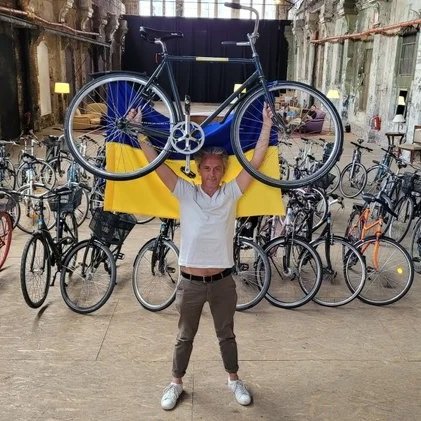
Mikael Colville-Andersen is the iconoclastic author of “Copenhagenize” and the forthcoming “Welcome to Analogville”, Founder and former CEO of Copenhagenize Design Company, and the host of the show Life-Sized City. Mikael is one of the preeminent voices in the bike transportation movement, though he has written, “I don’t identify in any way, shape or form, as a cyclist. I am just a modern city dweller who just happens to use a bicycle to get around because it is safe and efficient.”
Transcript
Avi Stopper (00:09)
Welcome to Bike Networks Now. I'm Avi Stopper, the founder of Bike Streets. Through a series of conversations with leaders in bike transportation and beyond, we're trying to answer a question: Why is bike transportation still not possible for most people in American cities, and how can we make it a reality? Despite voter support and billions of dollars of investment, there's no city in America where biking is a practical reality for people of all ages and abilities.
Why is that? And how can we fix it so anyone can ride to the places they want to go today? These aren't just freewheeling conversations — we're in search of an answer. And that answer, a modern approach to innovation, is the topic of a book we're writing on how cities can make bike transportation possible today.
Avi Stopper (01:06)
My guest is Mikael Colville-Andersen, author of Copenhagenize, founder and former CEO of Copenhagenize Design Company, and the host of the show The Life-Sized City. Mikael is one of the preeminent voices in the global bike transportation movement — though he has written, and I love this: "I don't identify in any way, shape, or form as a cyclist. I am just a modern city dweller who happens to use a bicycle to get around because it is safe and efficient." Mikael, welcome.
Okay, first question. You have written that the bicycle — this amazing analog device from the 1880s, basically unchanged in its basic form and function — is the single most important tool in our urban toolbox for improving our cities. Let's hear your basic pitch.
Mikael Colville-Andersen (02:05)
I think about all the things we need to do with our cities — and the list is long, and we're very slow in many places. I just think that the bicycle is literally the locksmith. It unlocks all these doors to everything. It solves transportation problems, it improves public health, it traffic-calms the city, it makes the place feel nicer. It just does all the things we need to do in a city.
I live in Copenhagen, right? So I'm looking out my window
Mikael Colville-Andersen (02:28)
and it's rush hour on bikes. I sit here all the time and I'm still amazed by it. I just see how it is the absolute — we talk about the urban toolbox, right? And I think the bicycle carries the toolbox. You know what I mean? A good old cargo bike filled with the tools we need for making cities better, man.
It's not some fun little bike activist theory. It's tried and tested for a hundred and thirty years all over the planet. So proof of concept's been established. It's just a question of getting back to it — going back to the future in some places, like your place, the States, for example. It's all there for the taking.
Avi Stopper (03:30)
It's an interesting paradox about how we live in this contemporary world, which is so much about innovation and the new new and all this newfangled stuff and gadgetry coming our way. And like I said at the top, the bike in its basic form is not that radically different from what it was when it was first introduced in the late 1800s.
How do you think about that idea — this rapidly modernizing technological society, and yet there's this kind of Luddite-esque counterpoint: this device, this piece of technology, which in its time was unbelievably forward-thinking, and yet is totally well suited to the modern urban landscape?
Mikael Colville-Andersen (03:55)
I'm a designer, so it's proof that good design is universal and timeless, right? There have been so many attempts, even back in the day, to optimize the bicycle. You have — what do you call that in English? Recumbents, right? Where you sit down and pedal forward. Dorkiest thing ever. And I love it that people dig it. That's fine.
Mikael Colville-Andersen (04:23)
In Europe it's really only like four countries where you see them. You never see them here. It's Germany, Netherlands, Belgium, Switzerland, stuff like that. I met these Germans once who were like, yeah, the recumbent, man. And I'm going, yeah, no — I'm single, I'm trying to get a date, dude. I'm not going to ride around on one of those. And they're going, but it's the most efficient way to cycle. And I'm going, there you go. Some Germans figured that out.
So, all this constant optimization, or attempts at it. And my bike in my backyard, dude — it looks like the same bike that my grandfather would have ridden in the 1920s here in Copenhagen. Lighter, probably a little bit, not that that matters. But it's just the same damn design.
And you look at the bikes that we ride in Copenhagen, and in the Netherlands — the ladies' frame and all that. These are the most produced bicycles in history. All your racing bikes for all the spandex dudes, yeah, there's a lot of those around. But if you look at the actual production of bicycles over the past hundred and thirty years, it's like seventy percent are the same damn frames, because that just works.
Avi Stopper (05:35)
I love this idea that you can get across your city powered by a carrot — or a light breakfast can get you across an entire city. The efficiency is astonishing. If you think about the caloric requirements to power a car to get across a city, it is just so radically different.
I want to ask you about a term you used a moment ago: design. It seems like that's one of the real through lines in your work — this distinction between design and engineering. Even as you're describing sitting there looking out at the world unfolding in front of your window, there's a lot there involved in observation.
Avi Stopper (06:27)
So let's talk a little about how you see that distinction, and why you think we need to move from an engineering-focused culture, in terms of how we think about making active transportation a reality, into a design-oriented approach.
Mikael Colville-Andersen (07:05)
Okay, that's going to be fun. I'm not a fan of traffic engineering. And I work with traffic engineers. I've worked in a hundred cities around the world on urban design projects, designing bike lanes and all that. It's a different animal, man. And that's fine — it's just a different way of thinking.
The problem is that we have placed traffic engineers especially, for more than a century, on a pedestal that they don't deserve.
Cars started to inundate American cities first, globally, back in the teens, the twenties. And there was a massive traffic safety problem. Cars just destroyed everything. People were dying. It was insane, man. And then they desperately looked for solutions.
Engineers back then were doing some good work. They were figuring out how to get plumbing into buildings, and electricity — great things in our cities. So people were kind of like, oh my God, you guys do stuff, you fix stuff. Can you do traffic now? And they're going, I don't know. Okay.
Look up the phrase "traffic engineering" — it's quite late, actually, because it didn't exist. So they were just thrown into the fray trying to fix traffic, and it never worked. What a shitty industry to work in, because you've basically done nothing for a hundred years.
And modern traffic engineering literally is based in the 1950s. The mathematical models they use, the traffic modeling techniques — I'm not even joking — they're stuck in the 1950s, maybe '60s. It has not modernized. If you imagine medicine in our daily lives was still stuck in the '50s — I don't know, would we have leeches on our bodies to heal us from cancer? Or education, all these different things. And yet this all-dominant force in our cities is the most old-school, unchangeable, conservative industry.
Mikael Colville-Andersen (08:35)
So that's the main problem: that we place them on a pedestal. And many, many countries do this. If you're the urban designer in a city, you can't even get meetings with the traffic engineer. I know this. I have colleagues who tell me this — they don't even get the meetings. Urban design, or urban planning even. So that has to change.
And we can see that in certain countries. In Denmark, for example, on the educational level at university, the traffic engineers are already interacting with the urban designers and planners — and, which is very normal here, urban anthropologists, geographers, social workers are on many projects when we're designing buildings or streets and stuff. They still have a little bit too much influence in some ways, but they are around a table. There's a team, and in principle everybody's equal.
Whereas, like I said, in most other big countries — especially big countries — the engineers are just all-dominant. It's like Moses on the mountain. You cannot speak against that. Except it's not a clay tablet, it's an asphalt tablet.
Avi Stopper (09:55)
An asphalt tablet.
Mikael Colville-Andersen (09:57)
And it's just crazy, dude. For me — there are probably lots of challenges we face, but if we're really serious about it, that's the first one. I really believe that the influence traffic engineers have had for so long is so destructive.
And you guys, with your litigation society and all your lawsuits — where's the class action lawsuit for the tens of millions of people who have died on the roads of America, designed by traffic engineers who couldn't make them safe enough? There's an opportunity for somebody with a lawyer friend. That would be the greatest class action suit in history, dude.
But yeah, it just pisses me off that we have to deal with this still. Good question, man. But my God — twenty years in this game and it's still this all-dominant question. And on that exact point, I don't see a lot of progress. You see cities that are above and beyond, really doing great work in a short amount of time, mostly in Europe and stuff — the zeroes to heroes. So they kind of jig their system a bit, but there's still the engineer in the room.
Avi Stopper (11:05)
Illustrate with an example or two: an engineering approach to a problem where you think a design approach would be better. Let's hold off on what you mean by design for now — but illustrate the problem that an engineer brings to a particular use case, a situation, a problem that they're trying to solve.
Mikael Colville-Andersen (11:25)
First of all, if you go out and Google "traffic engineering jokes," you're going to find a website. So it's kind of a thing.
It's like I said before, when I said mathematical models. I love my engineering friends. I love the way their brains are, and that's an important brain to have in a society. We need engineers, absolutely — just not the influence that they have in traffic.
But it's literally looking at established models and saying, okay, let's jig that a little tiny bit and try to improve it. But they never can. So you're looking at a spreadsheet, as a metaphor, where I'm an urban designer: I stare out the window, I sit on a bench, I study human behavior, I try to optimize an intersection for bikes based on how people are using it, how they're deviating from the traffic laws. That's not a problem for me. That's a solution.
Mikael Colville-Andersen (12:14)
A potential solution. You study humans, right? Whether it's a public space or a bike lane.
Engineers don't, really. Humans are not bothered with in their work. They just refer to pre-existing mathematical systems and models that they've been trained to learn at university. And I know many engineers — they tell me, yeah, my four years at university, blah blah blah. And it's the same in Croatia as it is in the States, as it is in Australia. It's just the most unmovable education. And like I said, nothing is ever new in it. They don't inject new learning or findings, because they don't have any.
Avi Stopper (13:15)
When you don't look at people — and we'll get to this design and observation thing in a moment — I want to ask you about a specific quote-unquote best practice that I feel like we encounter all the time. Talk about the asphalt tablets.
It's basically a traffic count — a total adherence to a traffic count as the indicator of whether a street is optimal for riding a bike. And the way it goes is basically: we have now reduced vehicle volumes to, say, two thousand a day, or a thousand a day. Therefore this neighborhood street is now a bike boulevard.
And I contrast that with the observation side of things, which is that usage of it by people riding bikes might actually be super low. Would you say that's an example of this engineering mentality — where it's like, if we reach fewer than this many cars on this facility a day, then we have achieved our goal, as opposed to a human usage goal, a behavior-based goal?
Mikael Colville-Andersen (14:09)
Yeah. Engineering is numbers, right? And we need targets, generally, in urbanism. We build a bike lane, we want to know how many people or more are riding on it, and the public health benefits, of course. But yeah, it's just so carved in stone. Well — asphalt. I'm going to roll with the asphalt metaphor there.
But no, it's two different ways of talking. It's one city, but then there are two completely different dialects, and they don't really communicate very well together.
Did you want me to answer that more specifically?
Avi Stopper (14:55)
Yeah, I'm curious about that specifically, because it's a constant point of friction. In the advocacy that I encounter, it's basically: okay, this is actually a really good bike facility, because we now have vehicle volumes below this number. And I go sit out there on the curb or on the park bench and I'm watching it, and there's very little usage of it from a rider perspective.
Or worse, I'm out there riding it, and there's a very significant concentration of vehicular traffic at rush hour when work gets out. So during the most potentially important time for cycling, it's actually a very unpleasant environment.
What's your take on that — worshipping at the altar of the all-telling vehicular traffic count as the indicator of whether this is indeed an adequate facility for people to be using on bikes?
Mikael Colville-Andersen (15:49)
Well, the automobile is, of course, at the top of the food chain in so many places. So when you're the engineer: yeah, we're going to put in that bike lane, but buddy, that's going to negatively impact the flow of traffic down this road. And we have this many — they all default to, is this a problem for cars?
And this traffic engineering culture — the rest of the world adopted it from you guys, back in the '30s and '40s.
One of the cool things we did in Copenhagen a few years ago — it actually was a bit of a battle, even with Danish traffic engineers. The default was always: hey, we're going to put in a bike lane, or we're going to do this or that. And then the question was, how does this impact automobile traffic? That was the default. And then you had to prove that it wouldn't be that much of an intervention against cars. Or if it was, then you had trouble even talking about it.
The mayor we had at the time just flipped it. And not many cities in the world have been able to do that. He said: for any new intervention, the question is, is this going to negatively impact bicycle traffic? It will? Well, then you have a problem. The opposite. An incredibly important development that very few places have actually done.
And that's what you're talking about, man. Anything that negatively impacts the flow of cars, based on 1950s models — the whole conversation stops and everybody goes home. I always talk about how this is really transportation dictatorship. For the past seventy years all over the world, the one dominant beast gets all the influence and everybody else, get the hell out of the way. And anything new — my God, no, no, no. We have our perfect paradigm, says the engineer. Which isn't perfect, because people die every day.
But that's such an irritation. And they are irritated, because now we have to have bikes, says the mayor. We have to squeeze them into this matrix that we have created for ourselves. And bikes are just an irritation. That's why you have these discussions about the numbers and the flow and all that.
Mikael Colville-Andersen (18:07)
That conversation has to change drastically. But that's also removing the influence from the engineers again.
Here we know — like anywhere in the world — that an average car lane can move about 800 to 1,100, 1,200 cars per hour when it's flowing smoothly, which of course isn't very often. And here we know that we can move up to 5,900 people on bikes down a best-practice Danish unidirectional bike lane. We know this. And so we don't have these conversations anymore. Hey, we want a new bike lane on this street. Fine. We've had the data for forty years now. You can't argue against it.
Whereas you guys over there have a problem being able to prove these things, because they don't care about Copenhagen or Amsterdam. Look at the numbers from Copenhagen — we don't care, man, we're Denver, we're Houston. So you don't have a lot of local, meaning American, nationwide data that proves things. It's a constant battle.
Avi Stopper (19:15)
We'll get to Copenhagen itself in a few minutes, and I want to talk about design as well. But just quickly — disarm that argument. How do we deal with "we don't have these proofs of concept, these things have not been demonstrated adequately"? And when we reach for examples that do exist, we get that exact response: yeah, this ain't Amsterdam. This is not Utrecht. This is not Copenhagen. This is not Portland — even something domestic.
It's a bit of a catch-22, because it's like: show us the money, where's the proof? And we say, well, we don't really have it here locally, because it hasn't been done at an adequate level. And so we look abroad, or domestically, for those proof points that do exist — and then we get that "this ain't Portland" response. How do you suggest we deal with that argument?
Mikael Colville-Andersen (20:05)
Generally, I always say that the bike people have got to kind of stop talking about bikes only. Do you know what I mean? It's a subculture. In your part of the world, it's a subculture. Even if it's a family riding their bikes to school every day and they don't do the spandexy things on the weekend — just regular city people in America — it's still regarded, because of the low numbers, as all those people with their uniform and the plastic hat and all that stuff. So that's a perception thing.
And what I often say is that we've got to change the question. For like eighty years, we've been asking: how many cars can we move down the street? That's all the engineers have ever been asked — by their politicians, by everybody. And when you change the question to how many people can we move down a street, my God, a whole new world of answers opens up to you. You know, 5,900 people on bikes. You've got a tramway — that's 50,000 a day in a busy city.
That's fewer car lanes, though. Sorry, not sorry. That's really the focus on one of our main arteries, a historical artery in Copenhagen. They literally asked that question back in 2007, and increased the number of people moving down this corridor by like sixteen thousand people a day, because they widened the bike lanes, they made bus lanes, no through traffic for cars. And it's a real pain in the ass to drive on that street now. But there are still cars there — just not as many as before.
So: how many people? That's all we need to know in cities with urbanization. We've got more people coming, and we've got to move them. There are literally better ways to do that.
Avi Stopper (21:54)
Let's contrast engineering a little with design. We've been dancing around this, and maybe an entry point is a word you used a moment ago: observation. What is the designer's approach to thinking about how a city should look, feel, be experienced, and work — with observation at its core?
Mikael Colville-Andersen (22:25)
Well, let's backpedal a bit and talk about design generally. I'm talking to you on a phone. It's on a stand — a cool magnet stand that I use. Designers made these things. A design team somewhere in the world made this phone, and your phone. And yeah, their company wants to make money, fine. But they are designers, so they are thinking about the end user. They want to give me a good design experience, and you as well — user experience.
So design is a human-to-human process. The human at the end of the design process is the goal. Traffic engineering, it's not — it's increasing the number of cars, all these things we've talked about. So that's really important.
The people define the city. And all the great thinkers know this: Jane Jacobs, William H. Whyte, everybody. The people are using the city. So the city is a design object. And if we want people to have a better design experience, user experience, in the city, then we look at what they're doing.
If there's a chaotic intersection. If there's a park with some benches and nobody ever sits on them, and you're going, but there are trees and stuff — the people are the users. And I really believe — well, it's poetry, man — but a city is a design object.
Avi Stopper (23:38)
They are pretty remarkable and wild organic beasts in many respects. And yet a lot of it is really determined by how the built environment is designed and organized.
What I see is a tremendous amount of work up front — imagining, envisioning, public meetings, conversations with people, asking people what they want in the future. It's kind of like design, design, design — or engineer, plan, plan, plan, plan — and then build, and then move on. With very little observation ex post facto, after building, in terms of how the things are actually used.
And having designed products throughout my entire career, what I've come to really understand and appreciate is that it's not so much what people tell you they want. People have a lot of difficulty, candidly. There are a lot of cognitive biases that get in the way of people being able to project their future behavior.
And yet what I think we see a lot, at least in American cities, is a tremendous amount of work up front before you build, then you build, and then you're done with that, and then you move on. We seem to overweight or overvalue process before construction, rather than observation and iteration on the design once the thing is actually in the real world for people to interact with. I'd love to hear your take on that.
Mikael Colville-Andersen (24:50)
Again, it's the same thing, man. We're locked into systems that have been in place for so long that it's so difficult to untangle ourselves — or unhandcuff ourselves — from them. And it's difficult to convince the people inside the system that their system just doesn't work. Yeah, but we've been doing it for so long. Yeah, but it's broken. Yeah, okay, maybe, but we've been doing it for so long. There are no new ideas. You know what I mean?
Mikael Colville-Andersen (25:37)
And that's where designers and thinkers come in and say: yeah, what if we do things differently? Like the mayor in Copenhagen who flipped the whole paradigm and said, new traffic project — if it negatively impacts bikes, then that's a problem. Where everybody else is still focused on the cars.
So that's the general take. And once we're talking about this, I'm going, wow, it's everywhere. You look at all the things that impact our lives. The automobile industry — that's a system. That is a massive monster system. All the components in the car, all the materials, the gas, the tires. It's a huge system. Concrete for construction — oh my God, it's hard to break out of concrete, because that has been established for so long. So we're just victims of all of this massive global system.
It's hard to change the conversation when you can literally get traffic engineers to admit, yeah, there are a lot of people dying. But that's how we do things.
God, I'm talking a lot about traffic engineering, Avi. Sorry. It's your fault, you're asking the questions.
But I had this one dude after a keynote. He came up to me — and I was kind of going hard on engineers in that talk — and he says, I'm an engineer, man. I just graduated. And I'm going, sorry, buddy. And he's like, no, no, no. You're telling me that there are other problems to solve than the ones I just learned about for four years? And there are others? I want in. How do I get in? He was so excited that there are others. He says, I'm an engineer, I want to solve problems. You just told me there's a whole new box of problems that need to be solved. I am so excited about my career now.
Avi Stopper (27:05)
There do seem to be a tremendous number of incredible opportunities, just based on the number of inadequacies that exist out there. How would you describe your process, your approach to design — your approach to solving a problem, top to bottom, in the built environment?
Mikael Colville-Andersen (27:32)
Looking at people first.
Outside my apartment, when I started my company way back in the day — like 2010 — I was looking around for data about how many Danish, or Copenhagen, cyclists break the law. I was just curious one day. And I could find nothing. Nobody had ever even looked at this. Ever. And I'm talking even back into the twenties and thirties — I could find nothing. And I looked around in other cities and countries, couldn't find anything.
So I said, all right, team. We stuck a camera out the window here and we filmed this really crappy intersection by my apartment for twelve hours. And then I hired an anthropologist. Never mind anything else — just look at these humans, and then map out exactly where everybody's going, and look for deviations from the traffic laws. There's probably tech that we could use now for that, but it was just so much more fun to spend 250 hours on direct human observation. And just discussing it.
I ended up looking at 80,000 cyclists in total in Copenhagen, and many intersections. And I finally found the number. And it blew everybody away — because even here, there's the whole "those damn cyclists," even though we're all cyclists. It's super weird.
I'm asking colleagues, how many people broke the law in this intersection? Like twenty, thirty? The mayor of Copenhagen is going, fifty, sixty, I don't care, bikes are awesome, I don't care if they — he was a really provocative guy. And I said, yeah, everybody: it's six percent. And nobody believed it. Here's the data. And it blew everybody away.
The Danish Road Directorate looked at this and did their own study based on it, to compare. For them it was 4.9 percent. And we're still having conversations about cyclists breaking the law. There's a whole world of psychology you can get into about why people's perception is completely wrong based on data.
But the whole thing is: look at the people, dude. And then you work backwards from there — or forwards, I don't know. You could be philosophical either way. How are they using the space? How did they design it wrong? Why are they breaking the law at that location, but they don't do it there? It's the design.
I was hired by the city of Amsterdam to look at ten intersections and film them, and fix their weird Dutch design in their city, because they have fifteen percent
Mikael Colville-Andersen (29:49)
of the population breaking the law. So they need to have some more design fixes.
But yeah — it's just the people who determine everything, man. And then it's pretty easy. When you're not working inside a system, or an academic system that you learned at university and this is how we do things, it's really hard to think differently. When you come at it freestyle, man, you eliminate a lot of baggage, and you can just go: that sucks, well, let's fix it. You don't have to worry about, but I read a study about that. No — who cares about the study? The study's outside your window. And they're walking past, they're riding bikes past, right now.
Avi Stopper (30:35)
You mentioned the Netherlands. I wanted to turn to the story of certain European cities, most notably Copenhagen in this case.
I was just riding in the Netherlands, and I had this loop playing through my mind that I had to remind myself of, as I was going from one incredibly wonderful cycleway to a fietsstraat to this, that, or the other thing, just rambling around the city: that what I was experiencing is really a very late-stage bike network. Like network version 25.0. I kept reminding myself, saying, Avi, this is not the beginning state. This is network version 25.0. They have been working on this for decades.
And I'd love to hear you tell the Copenhagen cycling story as you understand it. Because what a lot of us from the United States do is we go there and we experience these networks in their very established states. And we're like, we need to start building bridges, we need to build these really complex separated cycleways and intersections. And I'm just mindful of the fact that that is a very late version in this network.
Avi Stopper (31:53)
I know that you have done some journalistic work, some historical work, on the Copenhagen transformation. Help us understand where it started, and the progression. How do you tell the story of Copenhagen's transformation? What happened first, and then how did things proceed afterwards?
Mikael Colville-Andersen (32:45)
We're going back to — where are we going? 1892. The world's first dedicated bicycle infrastructure, in Copenhagen. There was one in the Netherlands, but it was for sports cycling. Here we took away an equestrian path in the medieval city center, because a lot of people were riding their bikes on the weekends, and we made this stretch. So that was fun.
1905 — no, sorry, 1911. There were more equestrian paths. Who was using those? The wealthy. Eat the rich. And people were saying, yo, we've got a lot of bikes now. It's 1911. It's insane, right? All over the world, but especially here. And they said, we need those equestrian paths. And the rich were going, no, no, no, we ride our horses on those.
And we have a cycling advocacy group — the national Danish cycling organization, founded in 1905, one of the world's oldest. And they went out and did a traffic count. This is one of the earliest examples of a traffic count I've ever found. They just stood there with their pencil and paper back then, and they said, yo, there were 8,000 cyclists and five horses, or whatever it was.
And the city — the mayor at the time, we're very horizontal now, but he knew all the rich people — he's going, God. Data. I can't argue with data. Fine. So they literally flipped it, man, and it became bicycle infrastructure. A great example.
But then 1913. In a street near here, they were going, this is crazy, man. All the bikes, some motorized traffic, but horses and carriages, pedestrians. They said, we've got an idea. Let's do a pilot. So they made a curb-separated bike lane parallel with the sidewalk, and then the roadway off to the side. Physical space. And there you go, buddy — we're talking about design. That was the gold standard in about eight seconds.
Mikael Colville-Andersen (34:09)
All of Europe copied it. The Dutch, the Germans, German cities until the '30s — everybody had it. London had it. You can still see remnants of it in cities like Liverpool, like archaeological bike lanes. Unidirectional, both sides of the street. This is just the gold standard. So: great innovation, and a pilot project that really proved its worth. And then things accelerated from there.
And we ripped out half of our bike lanes in the fifties and sixties to make space for cars, like everybody else. And then we started to return to that. The oil crisis in the '70s, near bankruptcy in Copenhagen in the early '90s — these were catalysts, and required a crisis response. So the Copenhagen we're cycling in today really is a product of the oil crisis in the '70s and a problem with bankruptcy in the nineties. A crisis response, basically.
Then you look at the Danes and the Dutch. It's like Barcelona, Real Madrid — you can argue which team you like best. I don't care. But as a designer, coming from a design nation, where my children learn Danish design in third grade — "Danish design" in quotation marks, it's a thing, man. They learn the three principles of Danish design, which are universal, carved in stone:
Avi Stopper (35:30)
Is that so? That's amazing.
Mikael Colville-Andersen (35:37)
Practical, functional, elegant. Boom. Whether it's a lamp, a chair, a bike lane, or an entire city.
So then — I've worked in the Netherlands, which is fun, because they've hired me and I've been there a lot. A lot of real estate for bikes. Oh my God, some of it is amazing. It's great. But is there any design thinking? No. It's chaos. You're riding on a bi-directional, and then you turn and you're on a unidirectional, and then you're on a bicycle street, and then there's nothing. My God.
I know Amsterdam so well, and I still don't know how to get around. And my friends who live in Amsterdam can argue about which is the best way to get to that bar. They all have like six different routes, and you probably all get there at the same time.
And I have a friend of mine, he's a grand old man in Dutch bicycle planning. And he always swore — damn it, we had the same standards that you had, that we all established. Again, this is also history: in the '20s and the '30s, all the standards we established are still the ones we use today, because they work so well. How wide do you need a bike lane going up a gradient, up a hill — all these different things, everything, man.
And he's going, yeah, but we just got lazy since the '70s. So they're putting in bi-directionals because it's the easiest solution for the traffic planners. It's too much of a bother, both sides of the street. So the Dutch are going, yeah, look at all this. And I'm going, yeah, it's great, man, but there's no design thinking.
I'm trying to keep it short. I'm really not very successful at that.
So many study trips, groups coming from all over the world, through twenty years. I take them on tours in Copenhagen about bicycle urbanism. A lot of them, for some reason, go to the Netherlands first. And then they get here and I'm going, hey, how was that? They go, oh my God, it was amazing, it blew my mind. And yeah — you're coming from the States, that's insane, man. You went to Disneyland.
And then they get here and I'm going, hey, so when you were in Amsterdam, could you squint your eyes and see Chicago, if you're from Chicago, or wherever you're from? And they're going, God, no. It's so different. It's a weird city, it's round, all these things. And I'm going, all right, cool. Here, we've been riding around for two days in Copenhagen. Can you squint your eyes and see Chicago here? And every single time they're going, totally.
Most of Copenhagen is almost a twentieth-century invention. We expanded quickly out from the medieval city center, so we have wide streets where we used to have trams. The architecture is different, but you can envision an American city here.
Mikael Colville-Andersen (37:59)
And that best practice, we have never lost it. Whereas the Dutch — like this colleague of mine said — yeah, we just got lazy, trying to cut corners on the budget. A bi-directional was cheaper, less of a hassle. You can go home earlier at the end of the day.
So that's the interesting thing. The Dutch hate this, but from a design perspective — I'm hired by the city of Amsterdam to fix the intersections that they designed. I just think that's hilarious.
But it's all good. It's Barcelona, Real Madrid, like I said. It's an argument at a completely different level of the discussion, when we're talking about Denmark or the Netherlands, compared to me talking to you in Denver.
But back to the design thing — and for you guys over there: everything's been invented. That's really kind of wild. It's not like a big "oh, everything's been invented." No, really. Everything we need to make a bicycle-friendly city, somebody invented a hundred years ago, ninety years ago. There's nothing new.
Well — the Dutch bicycle streets, which we also have now in Germany and Denmark and everywhere else, that was great. That's kind of a new angle, but it's still not that radical. You know what I mean? Everything's been invented.
So, twenty years in this game, also working in the States: it's really bizarre how that copy-paste, open-source design — why did that never happen? And why are you still having this conversation over there?
Davis, California, man. I have seen plans from Davis, which is your best bicycle city in the entire nation, still today. I saw the plans. And they were this best practice that I'm talking about. And then it just got shot in the face by Caltrans, or whatever they're called, in the '60s. If they had done that, you guys would have been in a different space. Look at Davis — still a great little bicycle city. But you guys were so close to starting the journey towards best practice, man.
I just find it fascinating how it's all been invented. We stand on the shoulders of a century of thinkers and planners and visionaries and engineers — everybody. And they just did the right thing. So, copy-paste, man. That's how easy it is.
Avi Stopper (40:25)
Hey, it's Avi here. Thanks for listening to Bike Networks Now. The conversations on this podcast are just one part of what we do here at Bike Streets. Every other week, our free newsletter highlights the people, projects, and ideas helping create places where more people can choose to ride. If you're passionate about better bike networks — or just curious about what's possible — we'd love to have you join us. Subscribe today at bikestreets.com.
Avi Stopper (41:02)
So, with that toolkit existing, having the precedent for how to actually accomplish this — you have said that you think it should take cities no more than five to ten years to build connected networks, which took Copenhagen thirty, forty years in the post-'70s era.
Describe how you see that process unfolding. How can a city practically — and I love this, by the way, our work is entirely around how we accelerate these timelines — how can a city, standing on the shoulders of giants, accomplish this in such a short period of time? I think that's a pretty revolutionary idea to a lot of folks, and I'd love to hear you really go deep on it.
Mikael Colville-Andersen (42:00)
Well, first the bad news. And I'm depressed about it. What I've noticed over the past two decades is — I know activists, bicycle advocates all over the planet. I can go to a random city and put it out on social media, anybody got a bike for me to borrow? Boom. So the network is so cool.
But every city that has gone above and beyond the call of duty and just rocked it, from zero to hero: it's all top-down. It's politicians who get it. You know what I mean?
And as you said, Copenhagen and Dutch cities have a very parallel story since the oil crisis. We were paralyzed, both nations. We were poor, a hundred percent dependent on foreign oil and gas. We were hammered, man. It was insane. But that created a crisis response, with bike lanes and wind power.
Wind power came out of the oil crisis. The wind power people were like hippies — literally, like, you're going to harvest the wind, you damn hippies? And then in the middle of the '70s, they went, how does that work? And a group of volunteers built the world's first wind turbine, plugged it in, and Denmark went, oh my God, that works. Now we're the world's leading wind nation. Today, ninety percent of the electricity in Denmark is generated by the wind. Every day.
Mikael Colville-Andersen (43:18)
Got in the wind there. Hang on. Where was I going with the bike?
So, it's top-down. You mentioned Copenhagen — this thirty-to-forty-year journey, and same with the Netherlands. We weren't in a hurry. We were just trying it, testing it out, seeing how do we get back to that. We had an insane network of bike lanes until the '50s. And there wasn't a lot of money, so it was a slow process. We weren't in a hurry.
Cities today, with climate change, with the scourge of the automobile still a plague on all our houses — yeah, we're in a bit more of a hurry.
So for me, the darling still is Seville in Spain. It's so irritating that that was in — like 2012, something, 2014, around there, whatever. A guy was elected mayor and he said, I get this. Here we go.
They call Seville the frying pan of Europe, because of climate change. Like 45 degrees Celsius. It's insane what they have to deal with. Heat. They went from 0.2 percent modal share for bikes to seven percent in four years, because an infrastructure network fell out of the sky — like almost in a weekend. There it was. And the people are going, huh, all right. And then they just rode bikes. And they had a bike share system as well. It was like the best story, man.
And another example, if you're interested: Ljubljana, the capital of Slovenia. They had a mayor in the late '60s. Like, late '60s, dude. This is Yugoslavia, the Iron Curtain and all that stuff. And he went, yeah, we've got two percent cycling in Ljubljana — a tiny capital, but still. And he went, I want more. What do we do? And they're going, I don't know, let's go to Copenhagen. Okay.
So he sent his people to Copenhagen. I don't know what they did, took photos with their old cameras back in the day. And they came home and they're going, this is what they do in Copenhagen, okay, we do that in Ljubljana. They built forty kilometers, really fast, and they went to ten percent modal share in a year after they expanded their network. It's just so great.
And I did a project myself — one of the best projects I've ever done, even though it was in Russia.
Mikael Colville-Andersen (45:39)
And after three years of volunteering in Ukraine, I'm not fond of speaking of Russia. But in 2014, a mayor of a small city in Tatarstan said, yeah, can you make us the Copenhagen of Russia? And we went, what? Okay. So we did this. We built fifty kilometers of best-practice Danish infrastructure. An oil company paid for it. It was the weirdest story ever, dude. And they went from basically no cyclists — like, I think I met the ten people riding bikes — to eight percent. In only four years.
So I don't know if I have the world record, but I think I beat Seville. Although Seville is the bigger city, it's the bigger story.
So there are great examples, recently and back in the day, of cities just going all in. And what is it? Political leadership, political will, and infrastructure network. That's it. There's no chicken and egg. There's only infrastructure. You can do nothing else.
Not a fan of your bicycle boulevards, man, in the States. I love it that you're talking about bikes, but that's pushing the bikes onto the detours — off, out of sight, out of mind, on that little quiet street.
We made mistakes here as well, which everybody should learn from. In the '90s, when we were starting to return — great numbers of people cycling again, the infrastructure slowly reappearing — on the busiest neighborhood street, the engineers and the planners said, my God, there's so much traffic and now the bikes are just starting again. Oh my God. We'll make a parallel route, and it'll be nice and traffic-calmed and stuff. And they spent a lot of money on it, at a time when we were close to going bankrupt. It was stupid money to spend. Completely flopped.
Everybody still went straight down the street. Because we're humans. We want to go fast from A to B. We will take the fastest route. It's in our DNA. And, to their credit, they went, oh my God, they just want to ride there. Fine. And then they built separated bike lanes, and that's now the world's busiest bicycle street. Still today.
So the whole detour-y thing, and sending cyclists on weird routes — all they're doing is going to the same damn job as the motorist, or to the same cafe, or the same school as everybody else. Second-class citizens, man. That's how many cyclists are treated around the world.
Mikael Colville-Andersen (48:02)
And these stories are, again: everything's been invented. People messed it up and fixed it, so that you don't have to. You know what I mean?
Avi Stopper (48:40)
Well, that's a sobering point, because a lot of our work is finding these networks hiding in plain sight, many of which use the parallel routes one street over. The political workability of a connected network of arterials has just seemed incredibly elusive in this country. And you're arguing for a connected network of bike lanes on existing arterial streets.
How do you accomplish that in five years, considering the incredible cost, the incredible conflict that that is going to create?
Mikael Colville-Andersen (48:55)
Okay. The conflict — we've spoken about that. You've got firewalls all around you in the engineering department. You can have a mayor elected, the most visionary mayor in the history of American cities regarding transportation. He's got to go talk to the engineers, and they're going to slam the door in his face. And they're going to say, we can't do that, dude. Mathematical models, like I said before. So that's the tricky part. And it's the same in many countries.
You said enormous cost. You haven't said one silly thing in this whole conversation, but you said that.
Avi Stopper (49:25)
All right, disabuse me of that. Why does it not cost much? I mean, a protected bike lane here is five to ten million dollars for a mile on an arterial street, if it's actually built with some proper fortification rather than a bunch of plastic ephemeral stuff that people dislike and that breaks down quickly.
Mikael Colville-Andersen (49:50)
How much does that road cost? You know what I mean? That's the thing — when we're talking about cost benefit. What does the road cost? What does it cost to resurface that road every, what, six, seven, ten years, however often you do that? It's a comparison.
In Copenhagen, we spent 280 million euros over a period of eleven years, until about 2017, on expanding our bicycle network. We built like seventeen new bridges around the harbor. We just threw everything at it. Two hundred and eighty million euros. You tell that to a mayor somewhere else and they're going, I don't have that money, that's insane.
But we also built three kilometers of motorway extension just north of the city center, to connect to this new neighborhood. I don't know why. But anyway, that cost — drum roll — two hundred and eighty-six million euros.
Avi Stopper (50:35)
Yeah. Fair.
Mikael Colville-Andersen (50:40)
That is the choice of a new urban generation. Do you spend 286 million on three more kilometers of motorway? Or do you spend the same number on a decade of investment in traffic-calming the city, public health, yada yada yada?
It's expensive when you look at the number, but not when you compare it to anything else. How much do roads cost? It's insane, man.
Mikael Colville-Andersen (51:16)
And that's motorways — they're expensive. But even urban roads, resurfacing all the time.
And then the cost benefit. I think one of the coolest things about this topic of cost benefit is that Copenhagen is the best city in the world for gathering data. I've worked all over the planet, and I have to look at another city's data and I'm going, that's all you have?
I was in Portland years ago, and it was November, a little bit drizzly. I met the head of the bike office, really cool guy, Roger Geller. And I'm going — hey dude, we're friends — I'm going, dude, where are your bikes? This is Portland. He went, yeah, it's a bit drizzly today. And I'm going, oh my God. And I said, but your modal share is like six percent or something. He's going, yeah, we only count during bike month in June. And I'm going, man, what? That's like fake news, man. That's like Fox News reporting right there, buddy.
And he's going, I know, I know, I know. And he's great, Roger Geller.
Here we just measure the hell out of it. We have bicycle counts at 200 locations every year. We have this website that anybody can go into — it's just insane, the amount of data. So that also stops conversations from happening at City Hall, because we have the data. You can't argue against any of this.
And when we build one kilometer of dedicated protected bike lane, Danish best practice, we know — because we wanted to find out, in the nineties, when we restarted this journey. We said, okay, we're going to do this again, let's measure the hell out of everything. We've been doing bike counts since 1972, but in the '90s it just went ballistic with bikes. So we know that the increase of cyclists will be on average ten percent. And the health benefits of that.
This is the tricky part: the rest of the world has universal health care, and not you guys. And so the money that Copenhagen
Mikael Colville-Andersen (53:12)
saves on public health, because we have 400,000 people riding bikes every day — more people are riding bikes here today than in your entire nation, dude. I still hate that statistic. I want that to change. But that's still the statistic.
And the money saved on the health benefits of this guy, this schmuck right here, just riding my big old bike around: I will live seven years longer. I will be stronger while alive. I will be less ill. I will call in sick at work less often. And I'm never stuck in traffic.
And the fun part of this cost benefit is: I will die quick. Healthy people die fast. We don't have to keep them on a respirator, give them a new hip because they're obese, whatever. The money spent on that. So we do the math and we're going, this makes a lot of sense.
So when you're talking about the big number, there are all these nuances to it. And what are we getting out of that number? My God. We're moving 5,900 people an hour down that street. They're healthier, they're on the workforce, they're going to live longer. It's just Christmas every day when you look at the data and the benefits of it.
The last statistic might be interesting for you and your listeners. Every time somebody rides a bike — like this guy, just going to my wine bar — I ride a bike one kilometer, society in Denmark earns 23 cents. Euro cents. Every time somebody drives a car in Denmark, we pay out 86 cents. We throw it into a big black hole and we never get it back.
It's the worst business model in the history of transportation. Cycling: literally the best business model in the history of transportation. And then you have public transport, which is also pretty awesome, but that's expensive. Bike lane — you get your damn bike, off you go. It's the greatest business model ever.
Avi Stopper (55:02)
I love that you're really intent on that return on investment. The lack of systems thinking, I think, is one of the great inhibitors — that there are these incredible positive externalities to be gained by a society empowered to use bikes to get around. And yet we are often just thinking about it, even as I was in the framing of my question, in the context of the cost of it, absent any other considerations.
All right, we could go on and on. I want to ask one more question that I think is really powerful and that folks should know about: the work you have done over the last few years in Ukraine. Talk about crisis — urbanism in crisis. Share a little about your experiences doing urbanist work, cycling-based work, in Ukraine. What you saw, what you've learned. And maybe, on an uplifting note, what gives you hope that the rest of us can draw from.
Mikael Colville-Andersen (56:00)
April 2022. Three months after the full invasion of Ukraine, I get an email from two urban planning colleagues in the city of Lviv, in the west of Ukraine, where all the internally displaced people were going. That city of 700,000 all of a sudden had 200,000 extra inhabitants, millions of people going through their train station, fleeing to safety in Europe. That's a city under pressure.
And these two dudes are going, what do we do? We're gridlocked. Public transport is over capacity. They said, I don't know, what do they do in Europe? And they go, they ride bikes for transport.
And my book, Copenhagenize, was coming out in Ukrainian in May 2022 — it came out in October, because of the invasion. But one guy's going, I just wrote the foreword for the Danish guy's book. And they're going, the Danish guy, we've got to ask him. He'll never answer. Like, I'm fancy, whatever. He'll never even see the email.
Did I see the email? You damn right I did. It was the best email of my professional life.
Mikael Colville-Andersen (57:03)
And I zoomed with them the next day and they said, can you get us bikes? Because you've got a lot of abandoned bikes in Denmark — like over a hundred thousand a year. And I'm going, I don't know how to do this, but I'm going to do this, man. This was a call to action, an appeal from professionals in my industry.
And I did it, man. In July, the first truck of donated bikes went there. We handed them to internally displaced people. And then I started shipping — I ended up shipping like 1,500 bikes. Most of them now are used by social workers and volunteers who still today, every day, are riding medicine, food, water out to the vulnerable people in the villages. A crappy Danish used bike is literally saving lives in thirty-five cities all across the country.
Then I stayed longer, because I was really invested in this. It's a crisis response. And this is what my next book's about, actually: how we respond to crisis, and how we can use war and disaster as an opportunity for positive urban change.
So I designed the first Nordic therapy garden and built it, to heal mental trauma. The first community garden in Kyiv. The world's largest tactical urbanism project ever, in a war zone, with volunteers, with air raid sirens and missiles. And we transformed a massive iconic square with benches and trees and all the great tools that we have at our disposal. Such an amazing experience.
So that occupied three years of my life. I've been home in Copenhagen now for a year. Still obviously think a lot about Ukraine, and advising people over there about implementing stuff. But it's wild to see how life exists in a war zone when you're just getting hammered all the time. And I've been close to the front lines and everything as well. I've been all over the place.
And that's what the next book's about. I studied the pandemic in great detail, because there was nothing else to do, basically — all my work was gone. But I said, this is important, man. How do people react to this, urbanist-wise? And how do cities react to it? And then I went into Ukraine for three years, and I'm going, okay, what's it like to live in a war zone? And all my observations — it's how they play into everything that's coming for us, man. The climate change, expanded war.
Mikael Colville-Andersen (59:28)
And the book is called Welcome to Analogville. And I can tell you, man — sorry, tech bros, we're not going to need you very much.
What makes the city of Kyiv function, three million people, when the Russians knock out the power, which they do all the time? Generators. It sucks to burn diesel, but a nineteenth-century invention by Mr. Rudolf Diesel in Germany still works today. Bikes. Local food sources. All of these things.
The future is analog, when we're trying to future-proof our cities against everything that's coming for us. And the bikes are a big part of that. In the book — yeah, I kept writing, going, yeah, me again, going to talk about bikes, you know me. But bikes are a big part of crisis response as well. And of building the future of cities.
So it's been a wild ride the last three years, dude. But I'm happy this book's coming out in April, and it's bikes, but it's everything. It's the future of our cities. So, looking forward to getting that out there.
Avi Stopper (1:00:10)
Congrats on the book. We'll keep an eye out for it — Welcome to Analogville. We'll have to have you back on then. This has been such a great conversation. Thank you for your work and your leadership. Great to chat with you, Mikael.
Mikael Colville-Andersen (1:00:35)
You too, buddy. Thanks so much. Pleasure.
Avi Stopper (1:00:43)
Thanks for listening. If you have questions, comments, or suggestions for guests you'd like to hear from, drop us a line at info@bikestreets.com. Bike Networks Now is hosted by me, Avi Stopper, and edited, mixed, and produced by David Childs. The show is a production of Bike Streets. Anyone should be able to ride a bike to any destination in their city today. You can learn more about our work at bikestreets.com.